Unraveling the origins of Supermassive Black Holes using Cosmological Simulations
CosmicAI researchers Aklant Kumar Bhowmick, Paul Torrey, and Alex M. Garcia explored how the earliest supermassive black holes formed in our Universe using cosmological simulations. They developed and analyzed the BRAHMA suite of cosmological simulations to test competing theories for the formation of the first black hole "seeds" and investigated how these different formation pathways influence the growth, mergers, and observable properties of supermassive black holes across cosmic time.
The team also collaborated with Laura Blecha, Luke Zoltan Kelley, Rachel S. Somerville, Rainer Weinberger, Priyamvada Natarajan, Tiziana Di Matteo, Lars Hernquist, and Mark Vogelsberger.
Understanding supermassive black holes
Supermassive black holes reside at the centers of galaxies and can be millions to billions of times more massive than the black holes formed from dying stars. Recent observations from the James Webb Space Telescope (JWST) have uncovered a surprisingly large population of supermassive black holes in the early Universe, many of which appear to be significantly more massive than expected for the sizes of their host galaxies. These discoveries present a major challenge to our understanding of how the first supermassive black holes formed. In particular, one of the biggest open questions is the nature of the first black hole "seeds" that eventually grew into the supermassive black holes observed today.
Using large-scale cosmological simulations
The team used the BRAHMA suite of cosmological simulations, spanning volumes from approximately 18 to 72 megaparsecs on a side, to investigate the formation and evolution of the first supermassive black holes. The simulations focused on heavy-seed formation scenarios, in which the first black hole seeds could be as massive as 10,000–100,000 times the mass of the Sun.
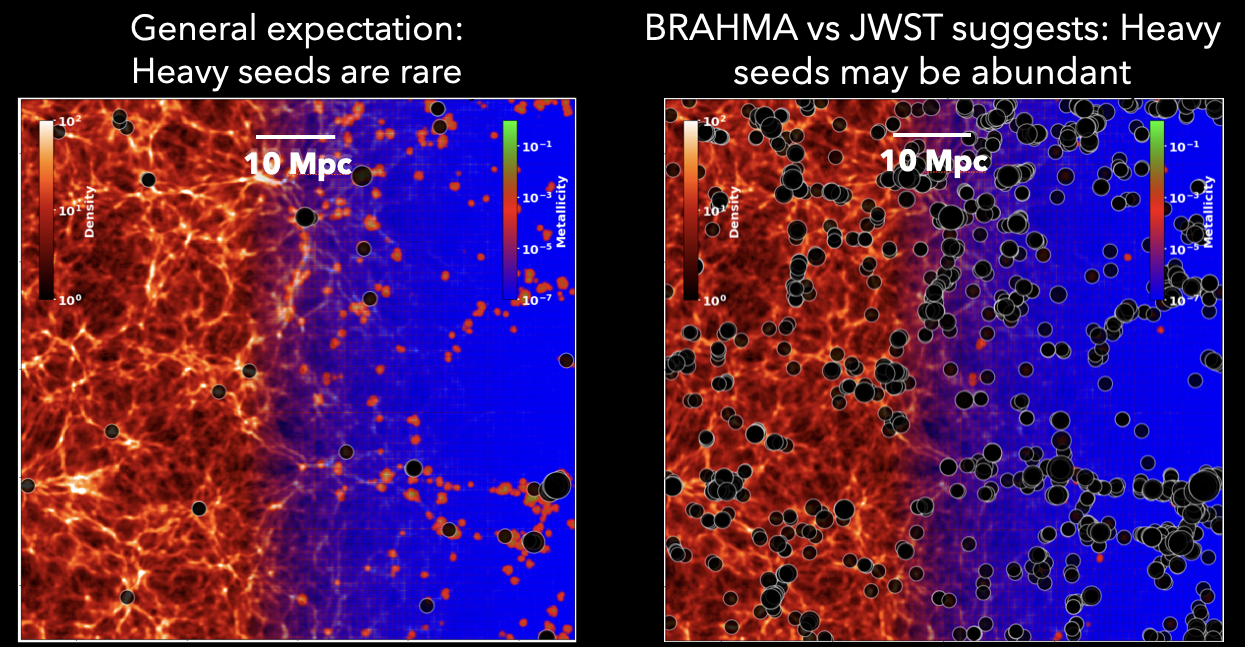
The researchers explored two distinct heavy-seed formation models. In a lenient scenario, numerous heavy seeds form whenever dense, pristine gas is present. In a strict scenario, similarly massive seeds form only under much more restrictive conditions thought to enable the direct collapse of gas, including rapid halo growth through major mergers, low gas angular momentum, and moderate levels of ultraviolet radiation.
What the team found
The simulations showed that both seed models produce black hole populations broadly consistent with the supermassive black holes observed in the present-day Universe. However, only the lenient heavy-seed model naturally produces a rare population of overmassive black holes residing in relatively low-mass galaxies, matching at least some of the systems recently discovered by JWST.
The study found that these overmassive black holes acquire much of their mass through the combination of initially massive seeds and subsequent black hole mergers, while also accreting gas rapidly enough to become luminous enough to be detected by JWST. In addition, the lenient model predicts substantially higher black hole merger rates—more than 100 events per year detectable by future gravitational-wave observatories—as well as a much larger fraction of nearby dwarf galaxies hosting central black holes than the strict model.
Why it matters / Significance
The importance of this work lies in demonstrating that different theories for the origin of supermassive black holes make distinct, testable predictions. While JWST is revealing the earliest massive black holes in the Universe, future observations by the Laser Interferometer Space Antenna (LISA), together with continued searches for faint black holes in nearby dwarf galaxies, will provide independent tests capable of confirming or ruling out these competing formation scenarios.
Our simulations suggest that, if the Universe indeed contains as many massive black holes in its early history as currently inferred from JWST observations, the formation of heavy black hole seeds may have been considerably more common than previously thought. By connecting theoretical models with multiple observational probes, this work brings us closer to understanding how the first supermassive black holes assembled in the early Universe.