Learning the Universe at High Redshifts: Impact of Accretion Modeling on Early Black Hole Growth
CosmicAI researchers Jonathan Kho, Dr. Aklant Bhowmick, Prof. Paul Torrey, and Dr. Alex Garcia explored the growth of supermassive black holes in the early Universe using different models for black hole accretion and seeding in cosmological simulations.
The team collaborated with Rainer Weinberger, Laura Blecha, Lars Hernquist, Greg L. Bryan, Niusha Ahvazi, Alejandro Saravia, and Boon Kiat Oh.
A puzzle from the early Universe
Supermassive black holes (SMBHs) millions to billions of times the mass of our sun are known to exist at the centers of most massive galaxies. However, it is not well understood how these black holes (BHs) got there, or how they grew to become supermassive. Recent observations from JWST have only made this mystery even more puzzling: SMBHs have now been observed to already exist by z=10, or when the Universe was only about 500 million years old, according to a standard ΛCDM cosmology. Such rapid growth has historically been extremely difficult to reproduce in cosmological simulations, posing a difficult challenge to current theories of early galaxy formation.
Modeling how black holes grow
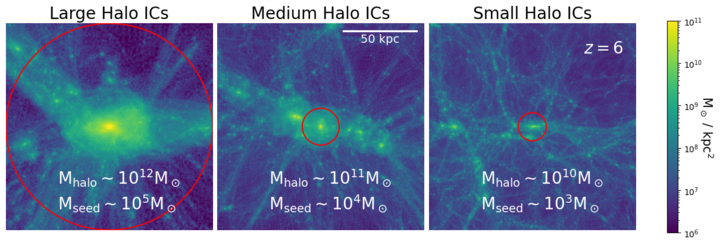
Typically, SMBHs have been included in cosmological simulations via fairly simple models. The standard Bondi-Hoyle formalism for BH accretion, while simple and effective, likely does not accurately reflect the physical conditions surrounding SMBH accretion at most times, and has a steep dependence on the BH’s mass. BH seeding is also typically done by simply placing a BH of a certain mass at the center of a galaxy once it crosses a certain mass threshold (strict seeding). In this work, the researchers compared novel BH accretion (ff and modff) and seeding (lenient) models to the commonly used Bondi accretion and strict seeding models in order to test whether these new models are able to produce better agreement with the recent JWST observations of SMBHs in the early Universe. They also tested reducing active galactic nuclei (AGN) and stellar feedback strengths in order to allow more gas to be accumulated near the centers of simulated galaxies, boosting early BH accretion rates. These tests were run in three different environments, corresponding to relatively more or less massive galaxies, as shown below.
Whatever it is, the way you tell your story online can make all the difference.
What researchers found
While various combinations of accretion models, seeding models and reduced AGN or stellar feedback produced enough BH growth to reproduce some of the observed JWST BH masses, several mysteries still remain. One of these combinations, using Bondi accretion and strict seeding with reduced stellar and AGN feedback, was able to reproduce most of the observed JWST BH masses compared to at z=10. However, this simulated BH continued to grow in a runaway fashion, and was too massive by the end of the simulation (z=6). Another combination using Bondi accretion and lenient seeding with fiducial stellar and AGN feedback only reproduced some of the JWST BH masses at z=10, but had a z=6 mass that appropriately matched that of z=6 quasars. While the novel ff and modff accretion models produced stronger BH growth in the fiducial AGN and stellar feedback scenario, they failed to compete with Bondi when these feedback channels were reduced.
Why it matters
This work provides hints at possible solutions to the mystery of these rapidly constructed SMBHs. Perhaps stellar and/or AGN feedback truly are less efficient at early times, enabling the rapid (and possibly super-Eddington) accretion-driven growth of BH seeds at high-z. Or, many more BH seeds may have formed than previously thought possible, enabling the rapid, early merger-driven growth of BH seeds. Future work will need to be done on both the observational and theoretical sides to truly pin down how these BHs grew so big, so fast.