CosmicAI researcher Omkar Bait explored how ionizing radiation escapes from a rare class of tiny, chemically primitive starburst galaxies, which are nearby analogs of galaxies that reionized the early Universe, using new multi-frequency radio observations that trace their star formation without being blocked by dust.
The team collaborated with Daniel Schaerer (Observatory of Geneva), Yuri Izotov (Bogolyubov Institute for Theoretical Physics), and Biny Sebastian (Space Telescope Science Institute).
Understanding the nature of extreme star-forming galaxies
Some of the biggest questions in cosmology concern the "reionization era," when the first galaxies flooded the Universe with ionizing (Lyman continuum) radiation which ionized the large amounts of neutral hydrogen after the Big Bang. JWST is now revealing many of these distant galaxies: they are low-mass, compact, chemically unevolved, and form stars at a furious rate. But the intergalactic gas between us and them makes it nearly impossible to directly watch ionizing photons escape at such distances. To get around this, astronomers study rare nearby galaxies with almost identical properties — extreme star-forming galaxies, or xSFGs — that serve as local laboratories for the same physics.
What the team did
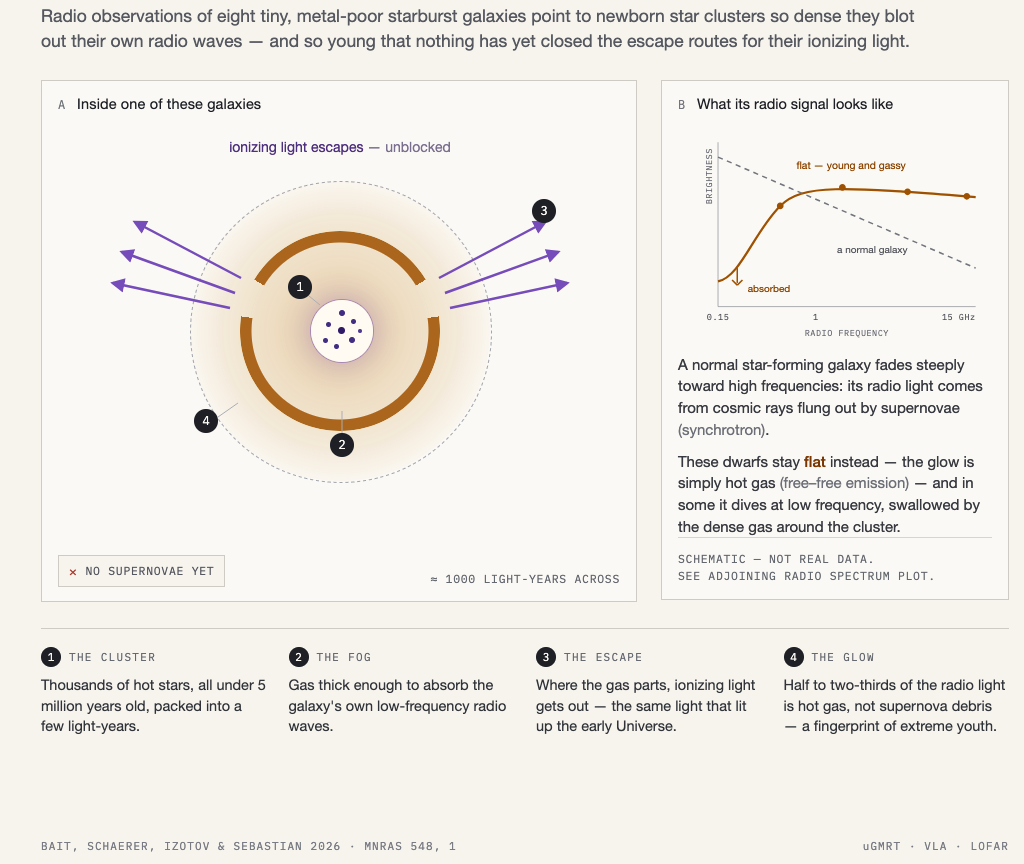
The team carried out new radio observations of eight low-redshift xSFGs, combining the upgraded Giant Metrewave Radio Telescope, the Karl G. Jansky Very Large Array across several frequency bands (1.5 to 15 GHz), and archival LOFAR data at 150 MHz. Together these span nearly two orders of magnitude in frequency, allowing the team to build detailed radio spectral energy distributions (radio-SEDs) — a map of how each galaxy's radio brightness changes with frequency. They then applied Bayesian modeling to separate the two ways galaxies emit radio light: "thermal" emission from hot ionized gas around young stars, and "non-thermal" emission from supernova-driven cosmic rays.
What researchers found
The radio-SEDs of these extreme galaxies look strikingly different from those of normal star-forming galaxies. Most show a flat spectrum between 6 and 15 GHz, and several show a sharp turnover at lower frequencies (roughly 0.3 to 3 GHz). The modeling shows these features are best explained by radio emission dominated by hot ionized gas, combined with an effect called free-free absorption that requires unusually dense conditions in the galaxies' interstellar medium. In other words, these galaxies are largely missing the non-thermal emission that normally dominates such galaxies. The team also found evidence for dust in several of them by comparing the radio signal to their hydrogen emission lines. Finally, they confirmed a link between a galaxy's radio spectral shape, its ionization state, and how much ionizing radiation it leaks.
Why the work matters
Because the escape of ionizing light can't be observed directly in the distant reionization-era galaxies JWST is finding, the radio properties of their nearby analogues offer a rare, dust-free window into what drives it. This work suggests that a galaxy's radio spectral index could serve as an indirect diagnostic of ionizing-photon escape — a tool that may eventually help interpret the extreme early galaxies now being uncovered. By connecting radio observations to the physical conditions inside these systems, the study brings us a step closer to understanding how the first galaxies ionized the neutral hydrogen at the cosmic scales.