Resolving galaxy formation in the early Universe with BonFIRE and CampFIRE
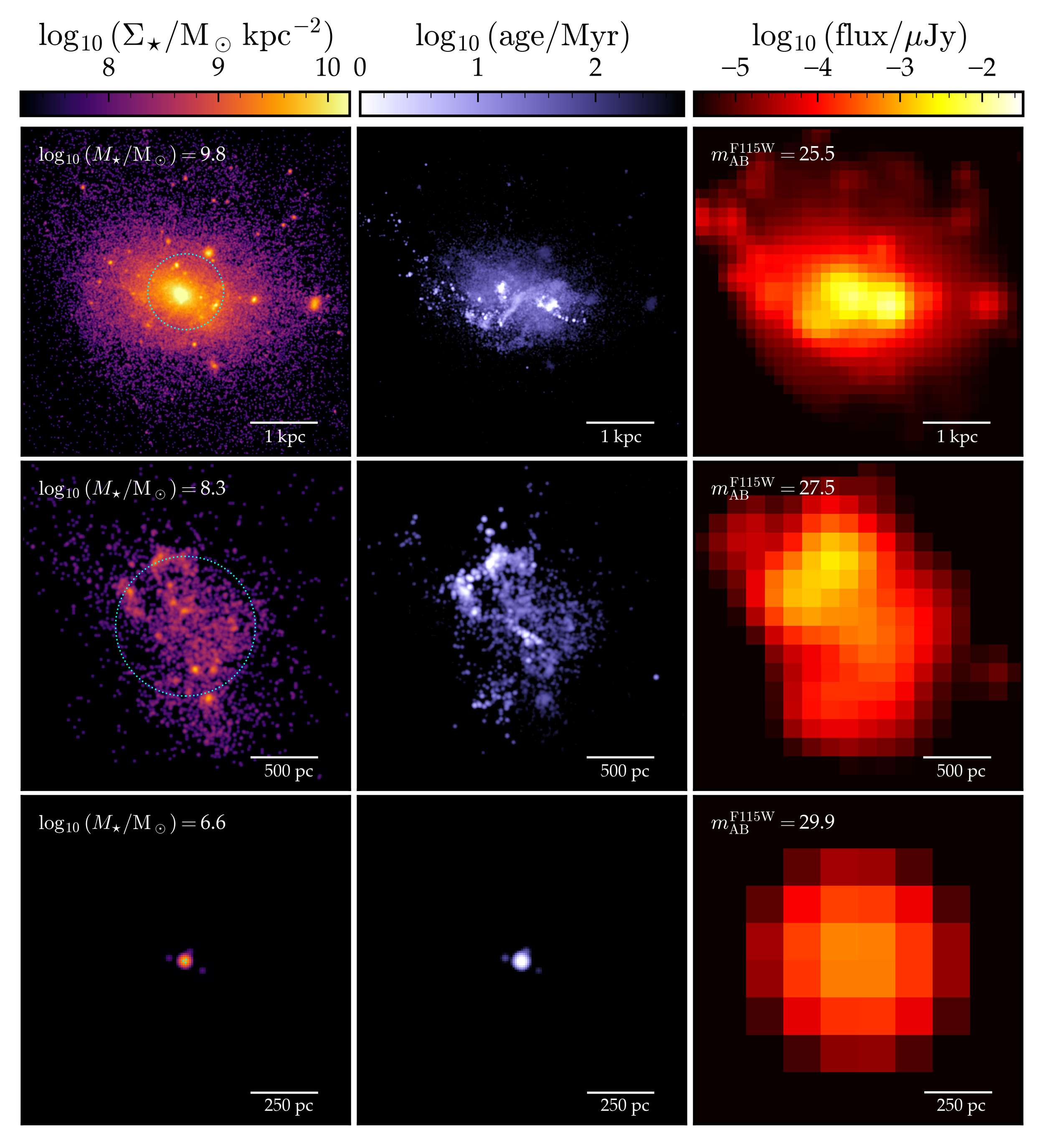
CosmicAI researchers Dr. Jenna Samuel, Prof. Michael Boylan-Kolchin, and Asst. Prof Julian Munoz explored how the first galaxies formed in the early Universe. Using cutting-edge simulations called BonFIRE and CampFIRE, the team investigated a major puzzle revealed by the James Webb Space Telescope (JWST): why do the earliest galaxies appear brighter, more massive, and clumpier than expected?
The CosmicAI team collaborated with Robert Feldmann, Philip Hopkins, Guochao Sun, Pratik Gandhi, Alessandra Venditti, Xuejian Shen, Andrew Wetzel, Jorge Moreno, Rachel Cochrane, Claude-Andre Faucher-Giguere, Volker Bromm, Steven Finkelstein, Maria Straight, Connor Painter, Jonathan Stern, and James Bullock.
Challenging Models of the Early Universe
For decades, astronomers developed models describing how the first galaxies formed. However, recent observations from JWST have challenged these expectations, revealing galaxies that appear more massive and luminous than predicted at such early times. Understanding this discrepancy requires new approaches that can capture both the large-scale structure of the Universe and the small-scale physics of star formation.
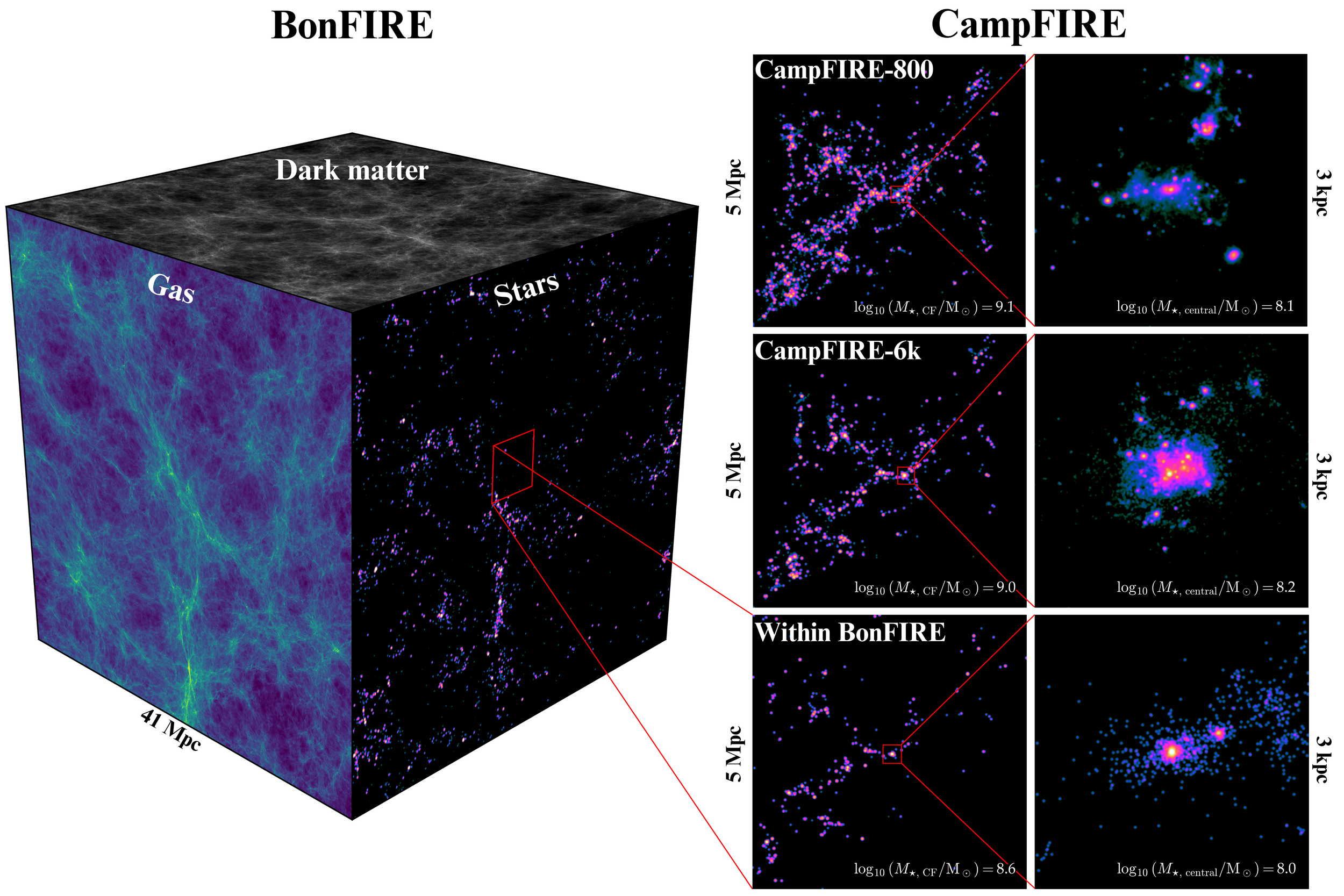
To investigate how the first galaxies formed, the team developed and analyzed two advanced numerical simulations: BonFIRE and CampFIRE. Each simulation captures a different scale of the early Universe, allowing researchers to study both large-scale structure and small-scale physics.
Two Complementary Simulations
BonFIRE models a large region of the Universe (about 10 million light-years across). This simulation is excellent for seeing the big picture, but it is difficult to see some of the finer details of galaxy formation.
CampFIRE focuses on a much smaller region (about 1 million light-years across) but at significantly higher resolution. This allows the simulation to follow the finer details of physical processes inside individual galaxies, including how gas collapses, how stars form, and how stellar feedback influences future star formation.
Bridging Scales
A key aspect of this work is the combination of these two approaches. The researchers use the detailed physical insights from CampFIRE to inform and refine their analysis of the larger-scale BonFIRE simulation. This enables them to connect small-scale galaxy physics with the large-scale distribution of galaxies - something that has been difficult to achieve in previous models.
Including the First Stars
The simulations also incorporate Population III stars, the first generation of stars composed solely of hydrogen and helium. By including these early stars, the simulations can help researchers understand how they enriched their surroundings and influenced subsequent galaxy formation.
Why it Matters
The scientists were able to create simulations that finally provide more insight into the early galaxies observed with JWST. They found that star formation is extremely clustered and efficient in the early Universe, leading to ultra-compact galaxies at the low-mass end of the galaxy population and extremely bright galaxies at the massive end – almost too bright compared to observations! This is just the tip of the iceberg for results from these simulations, as more collaborators begin to explore the massive BonFIRE and CampFIRE datasets.
Paul Torrey, Explainable Universe, Astro Lead said, "One of the most exciting aspects of this work is that it highlights a central challenge in modern astronomy: multiple distinct physical mechanisms can often produce observations that look remarkably similar. Within CosmicAI's Explainable Universe effort, we're developing AI approaches that help scientists quantify uncertainty associated with model assumptions and distinguish between competing explanations. Studies like this provide an important foundation for building AI tools that not only make predictions, but help us understand the physics driving them.”