Recovering high resolution information from blurred images crowded with stars
As part of the Explorable Universe Working Group, CosmicAI Researchers Knut Olsen (NOIRLab) and Jixian Li (TACC) led a project to recover high resolution information from blurred images crowded with stars.
The team collaborated with undergraduate students Alexander Wohlberg (Stanford University) and Sarayu Gadi (University of Arizona), who developed two different AI-based approaches to predict the true brightness of stars in severely blended images of nearby galaxies M31 and M32.
What the team did
Using images of dense star fields in M31 and M32 simulated to demonstrate the performance of ground-based telescopes and the Hubble Space Telescope, Wohlberg and Gadi trained machine-learning models to predict the true brightnesses of the stars in the images. They then applied one of these models to an observed Hubble Space Telescope image of M32.
What researchers found
The researchers found that the AI-model-enhanced image of M32 revealed tens of thousands of fainter stars that in the original image were hidden beneath the footprints of brighter ones. They measured the brightnesses of all stars in the new high-resolution image, finding that measurements reached more than six times deeper than ones made from the original, and contained roughly five times more stars.
Why the work matters
Populations of stars in nearby galaxies record the formation histories of galaxies through their ages and chemical abundances. We can infer these properties by careful measurements of brightnesses of individual stars. However, our ability to make these measurements is limited by the spatial resolution of our images, which cause the footprints of individual stars to overlap, especially in bright regions like galaxy disks and bulges. By getting deeper measurements in blended, blurred images, we can probe the histories of galaxies in much greater detail. These methods may prove especially useful when applied to images from the newly constructed Vera C. Rubin telescope, which will spend a decade collecting images of the Milky Way, with a significant number strongly affected by blended stars.
This work was presented at the Friday Scientific Lunch Talk Series at the National Optical-Infrared Astronomy Research Laboratory (NOIRLab).
View the slides here.
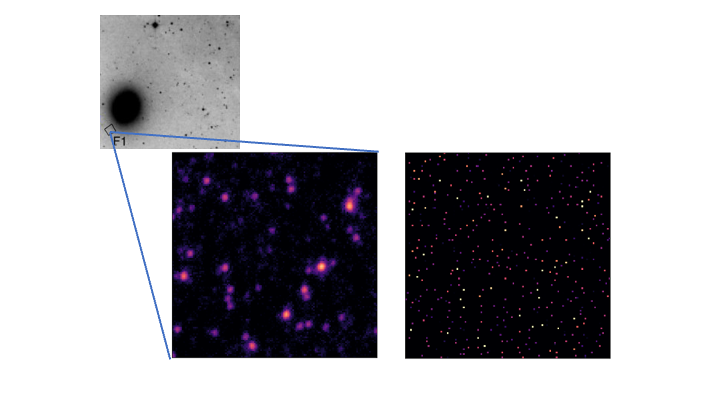
Original image from Hubble Space Telescope observations of the nearby galaxy M32 (middle image; Monachesi et al. 2011), with a portion of the team’s reconstructed high-resolution version for comparison (right image)