“Vector Summary Pseudo Posteriors for Simulation-Based Inference with Applications to Cosmology” presented at the STAI-X conference at Harvard
On August 1, 2026, Min Chen, a Ph.D. student in the Department of Statistics and Data Sciences at The University of Texas at Austin, presented the poster “Vector Summary Pseudo Posteriors for Simulation-Based Inference with Applications to Cosmology” at the Statistics and Trustworthy AI for Cross (X)-Domain Acceleration (STAI-X) conference at Harvard University.
The paper is authored by Pratik Patil, Jonah Rose, Alex Garcia, Min Chen, Paul Torrey, and Arya Farahi. The work was supported by the NSF-Simons AI Institute for Cosmic Origins (CosmicAI).
What the team did
Cosmologists often rely on computationally expensive simulations whose likelihoods cannot be evaluated directly. The team developed Vector Summary Pseudo Posteriors (VSPP), a lightweight and interpretable method that compares simulated outputs with scientifically meaningful targets, such as the average residual and residual scatter around galaxy scaling relations, and assigns more weight to simulator settings that match those targets.
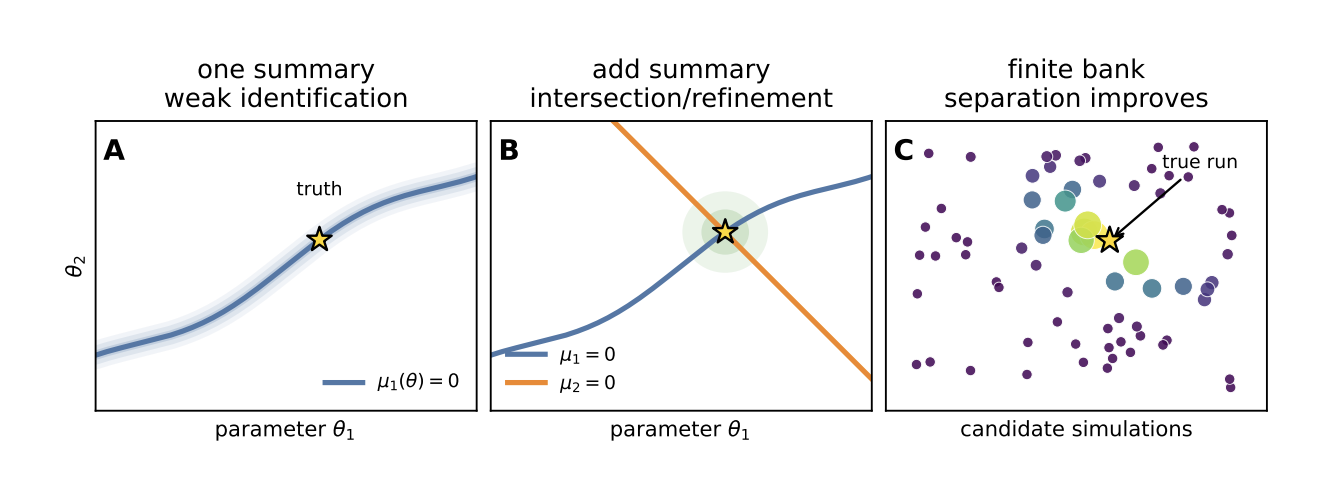
VSPP also makes the limits of the available information explicit. A single summary may identify a ridge or set of plausible parameter values rather than one unique answer. The paper shows theoretically and empirically how adding informative summaries can shrink these sets and improve recovery from a finite library of simulations. The method is demonstrated with synthetic examples and with the CAMELS IllustrisTNG and DREAMS cosmological simulation suites.
Why the work matters
Simulation-based inference can produce powerful constraints, but it is not always clear which scientific information drives them or whether the simulations truly identify a unique parameter setting. VSPP keeps each constraint tied to a named, inspectable summary. This makes the inference easier to interpret, helps diagnose weak identification and simulator-target mismatch, and avoids presenting false precision when several parameter settings remain compatible with the chosen scientific targets. These goals closely align with CosmicAI’s emphasis on trustworthy, interpretable, robust, and efficient AI for astronomy.
Building on Earlier CosmicAI work
The new paper builds on “Simulation-Based Inference via Regression Projection and Batched Discrepancies” by Arya Farahi, Jonah Rose, and Paul Torrey. That work introduced a computationally efficient approach that first fits an observed regression relation and then compares small simulated batches with it. Candidate simulator parameters receive higher weight when their mean simulated residual is close to the target. The method is parallelizable, requires access only to fitted regression coefficients rather than raw observations, and comes with theoretical guarantees describing its consistency and its point-versus-set identification behavior.
The earlier paper established the regression-projection pseudo-posterior and showed both its computational advantages and a key limitation: one scalar residual summary may leave many simulator parameters observationally indistinguishable. VSPP directly addresses that limitation by replacing the single summary with a vector of named targets—for example, residual mean together with residual scatter, or summaries from several astrophysical relations. This extension preserves the original method’s efficiency and interpretability while providing a principled way to add scientific information, strengthen identification, and reveal which summaries drive the result.